
Unhappy with the current situation and unwilling to sit around idly while waiting to be Odexed, angry anime fans are seeking to pursue legal means as a means of fighting back against Odex. Some have even taken concrete action, forming a community and starting a campaign to finance a legal recourse against Odex, which as of today has amassed a total of $3200.
All this is very admirable and shows anime fans are willing to put their money where their convictions lie. However this still begs the question: Do fans have a fighting chance if they bring the dispute to court? The Straits Times has interviewed three lawyers and they are of the view that it is unlikely the anime fans would win if they have been uploading or downloading anime. That is the lingo behind 'little basis for legal action', which basically translates into: No reasonable chance of winning the case.
I'm personally also of the view that anime downloaders who bring the case to trial are unlikely to win, that it is not a viable option and
stated a number of general reasons why. However I note that many remain unconvinced and adopt a "if you're never going to try, how do you know?" stance, which is a valid point. The problem is one has to recognise when there is a reasonable chance of succeeding and pushing to go to trial and when your case is legally shaky with few merits and an equally low chance of success. There is a reason why 95% of cases in Singapore
never go to trial. The parties settle because it is faster, cheaper and better to do so.
Before I continue, let me state for the record if this is not already clear that I do not approve of Odex's actions
AT ALL. They are legally entitled to do what they did( though the sum they are asking for is ridiculous) but what they are doing may hardly be called ethical. That said and done, instead of just parroting the lawyers' views and reiterating my earlier stand and being NATO (No Action All Talk), I'll address the legal elements like the Fair Dealing Defence and Section 136 of the Copyright Act (Offences) in greater detail.
Offences fall under Section 136 of the Copyright Act (Chapter 63) and the relevant provisions will be S 136(2)(b) which states:
(2) A person who at a time when copyright subsists in a work has in his possession or imports into Singapore any article which he knows, or ought reasonably to know, to be an infringing copy of the work for the purpose of —
(b) distributing the article for the purpose of trade, or
for any other purpose to an extent that will affect prejudicially the owner of the copyright in the work;
shall be guilty of an offence and shall be liable on conviction to a fine not exceeding $10,000 for the article or for each article in respect of which the offence was committed or $100,000, whichever is the lower, or to imprisonment for a term not exceeding 5 years or to both
or possibly S 136(3)(b):
(3) Any person who, at a time when copyright subsists in a work,
distributes —
(b) for other purposes, but to such an extent as to
affect prejudicially the owner of the copyright,
articles which he knows, or ought reasonably to know, to be infringing copies of the work, shall be guilty of an offence and shall be liable on conviction to a fine not exceeding $50,000 or to imprisonment for a term not exceeding 3 years or to both.
The important elements to note here are the distribution of the article(which includes videos, music files, etc) and that distribution is for some purpose other than for trade but which would prejudicially affect the owner of the copyright. This might also help explain why Odex is going after the BitTorrenters.
By downloading a file on Bit Torrent, you are at the same time uploading the various portions of the file the program has already downloaded to other downloaders on the torrent and this is probably sufficient to satisfy the element of distribution. As for the prejudicing the owner of the copyright law, this will likely be construed widely in favour of the copyright owner. There appears to be no local case law defining what would amount to prejudice per se but the general approach has been one of deterrence.
Chapter 27 of the Intellectual Property Offences Sentencing Practice (2nd Edition, 2003, Subordinate Courts) states that copyright infringement under S 136 is a serious offence and one of dishonesty for it steals from the true owner of the copyright. In all cases, deterrence is the
central consideration. Punishment is meted out according to the number of infringing articles, the role of the offender and the sophistication of the infringing operation. The prospects do not appear promising.
Which brings us to the Defence of Fair Dealing which after the 2004 amendment of the Copyright Act was considerably widened and strengthened. Fair Dealing in relation to works is under Section 35 of our Copyright Act and was derived from S 107 of the US Copyright Act ( 17 USC 107) even though the rest of our copyright provisions were adapted from the Australian Copyright Act 1968. Fair Dealing is a complete defence and while similar to the US 'Fair Use' Defence, is not identical. The US Fair Use defence is broader and more robust. Our current Fair Dealing defence is a big improvement over the pre 2005 version but it is
not Fair Use. There's no Fair Use defence in Singapore.
Andy Ho raised a number of pertinent points in
his article that revolved around the fair dealing defence in Section 35 that centered around the five factors listed in S 35(2). (Fair Dealing for the purpose of criticism or review(S 36) and Fair Dealing for the purpose of reporting current events (S 37) will not be discussed because it is not relevant here.) The effect of the dealing(of infringing articles) in ss 32(2)(d) is as Andy pointed out, that upon the potential market. I'm not too convinced by the actual harm part. If the company can actually show actual harm has been caused to the market, they would already have shown that such dealings have affected them prejudicially as per Section 136.
It must be pointed out and has also been noted by legal academics and the Court alike that the list of factors in Section 32 are inclusive and hence not exhaustive.(See Daniel Seng,
Reverse Engineering the New Reverse Engineering Provisions in the Copyright (Amendment) Act 2004, [2005] SJLS 234 at 240 &
Aztech Systems Pte Ltd v Creative Technology [1996] 1 SLR 683 at 702.
) What this means is that the factors in Section 32 are not
ALL the factors the court need to and will look at when considering whether the defence of Fair Dealing is made out.
In doing so, the court attempts to balance the interests of the copyright owner and that of the public (common law defence of public interest). But where it is clear that there has been infringement
and the copyright owner has suffered losses as a result of that infringement, the courts are heavily inclined to punish and penalise the offender as deterrence is and continues to be the main consideration.
So that's the main gist of the law part. It's certainly about the most detailed you'll get for unpaid work. Direct http links unfortunately cannot be provided as the mini research was done on
Lawnet which is not a free public service. The soft copy is with me though and may be provided if you request... nicely.
That said and done, if inspite of advice and evidence to the contrary one feels that pursuing legal options culminating in a courtroom showdown with Odex is viable, please do go ahead. After all, you really won't know till you've tried it would you? And if the campaign drive continues to do well, as it appears to be, money may just be
less of a problem. You decide.
Update:
A witty video parody of the Odex saga by NCHproductions. The angst, the anger, the Drama.


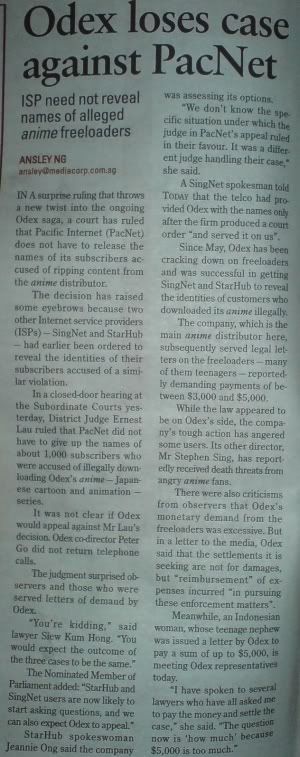


 Everything else that was mentioned like the where the settled sums were going to and the reasons behind Odex's dismal sales should be taken with a pinch of salt. A very very large pinch at that. Other things to take note of which have not been officially verified and I doubt it'd ever be. Still, no harm knowing:



